

 Image 1 of 1
In a world increasingly defined by division, The Lovers Rebellion imagines another force capable of transforming history—not through domination, but through devotion.
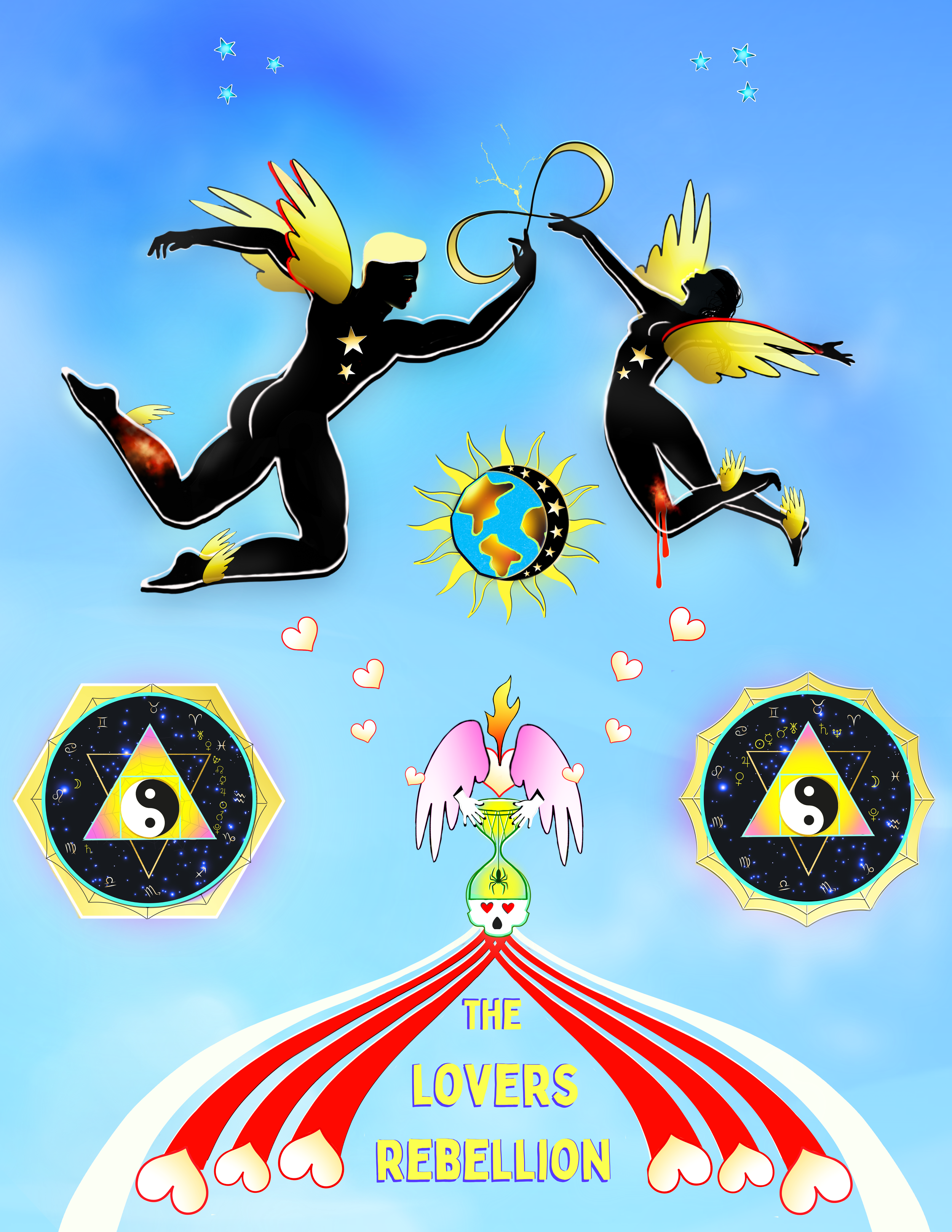
Two winged figures reach toward one another across the sky, their hands meeting within the symbol of infinity. Their encounter is charged with tension and possibility, suggesting that genuine connection is an act powerful enough to bend time, transcend limitation, and interrupt established patterns.
The figures bear both light and wounds. Their radiant wings speak of aspiration and transcendence, while the marks upon their bodies acknowledge the cost of choosing love in a fractured world. They are not untouched heroes, but participants in the eternal struggle between fear and openness.
Suspended between them, the Earth radiates like a celestial heart, suggesting that humanity itself hangs in the balance. Above and below, stars, hearts, sacred geometry, and cosmic symbols evoke the relationship between the individual, the universe, and the unseen patterns that connect them.
At the center of the composition, an illuminated vessel crowned with wings pours streams of crimson into a pathway lined with hearts. The image recalls both sacrifice and renewal, proposing that love is not merely an emotion but a life-giving force that must continually flow into the world. What appears to be loss becomes nourishment; what appears to be vulnerability becomes strength.
The mirrored mandalas on either side reinforce themes of balance, polarity, and harmony. Their union of opposing forms suggests that wholeness is not achieved by eliminating difference, but by integrating it into a greater order.
Rather than depicting rebellion as destruction, The Lovers Rebellion presents it as an act of creation. It proposes that the most profound revolution begins not with conquest, but with relationship; not with control, but with reciprocity; not with fear, but with the courageous decision to remain open-hearted.
The work invites viewers to consider whether love itself may be the most transformative force available to humanity—an infinite current capable of healing division and illuminating a path toward a more unified future.
In a world increasingly defined by division, The Lovers Rebellion imagines another force capable of transforming history—not through domination, but through devotion.
Two winged figures reach toward one another across the sky, their hands meeting within the symbol of infinity. Their encounter is charged with tension and possibility, suggesting that genuine connection is an act powerful enough to bend time, transcend limitation, and interrupt established patterns.
The figures bear both light and wounds. Their radiant wings speak of aspiration and transcendence, while the marks upon their bodies acknowledge the cost of choosing love in a fractured world. They are not untouched heroes, but participants in the eternal struggle between fear and openness.
Suspended between them, the Earth radiates like a celestial heart, suggesting that humanity itself hangs in the balance. Above and below, stars, hearts, sacred geometry, and cosmic symbols evoke the relationship between the individual, the universe, and the unseen patterns that connect them.
At the center of the composition, an illuminated vessel crowned with wings pours streams of crimson into a pathway lined with hearts. The image recalls both sacrifice and renewal, proposing that love is not merely an emotion but a life-giving force that must continually flow into the world. What appears to be loss becomes nourishment; what appears to be vulnerability becomes strength.
The mirrored mandalas on either side reinforce themes of balance, polarity, and harmony. Their union of opposing forms suggests that wholeness is not achieved by eliminating difference, but by integrating it into a greater order.
Rather than depicting rebellion as destruction, The Lovers Rebellion presents it as an act of creation. It proposes that the most profound revolution begins not with conquest, but with relationship; not with control, but with reciprocity; not with fear, but with the courageous decision to remain open-hearted.
The work invites viewers to consider whether love itself may be the most transformative force available to humanity—an infinite current capable of healing division and illuminating a path toward a more unified future.