

 Image 1 of 1
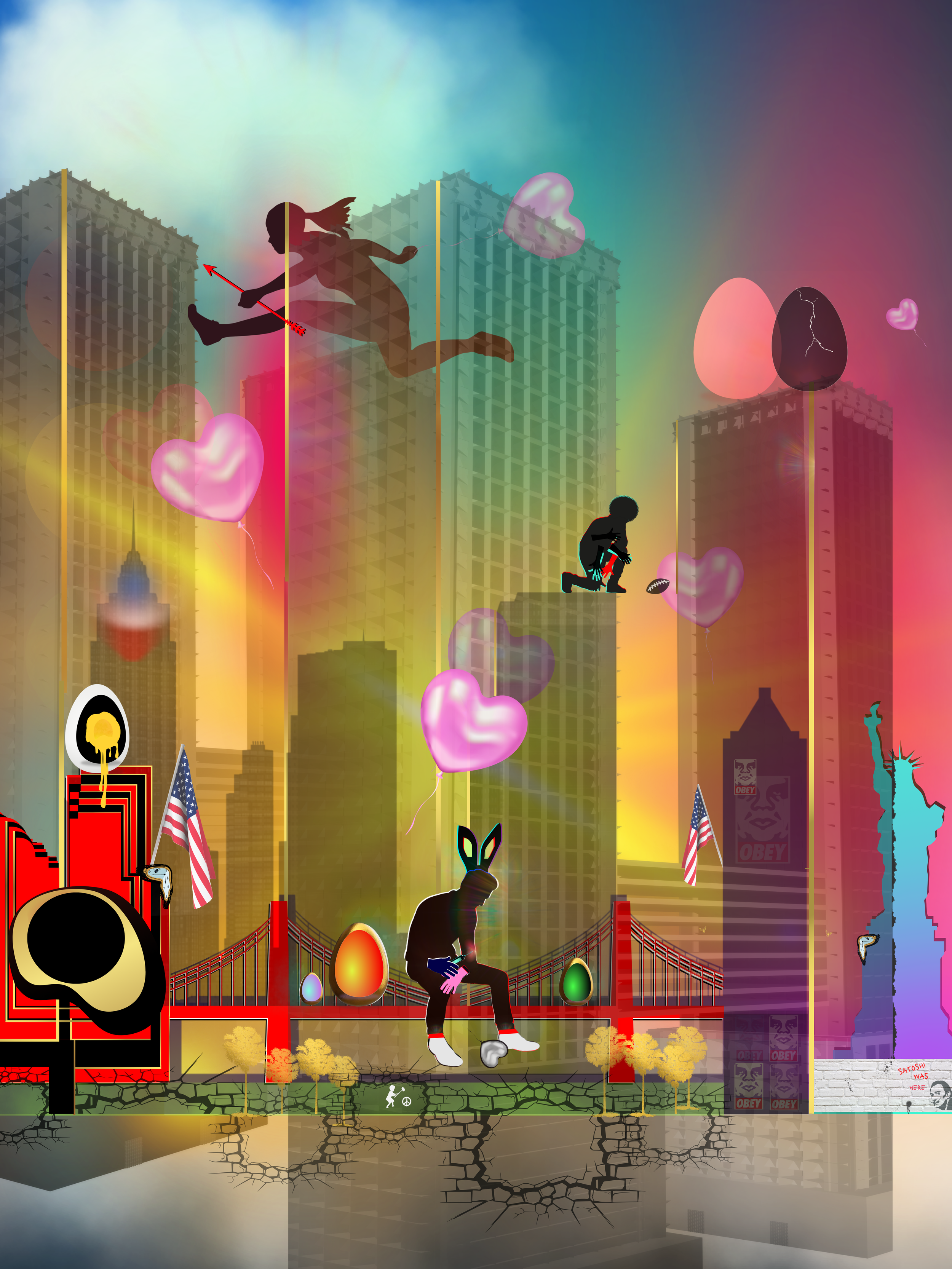
A city rises like a machine for living—but not for living well. Its glass towers glow in gradients of artificial dawn, sterile and controlled, as if even the sky has been optimized.
Below, Colin Kaepernick kneels—not in prayer, but in extraction.
Even innocence is mined here, harvested early. The body remembers how to run, but the system teaches it to kneel.
The rabbit-headed male waits—a symbol of fertility turned into fatigue,
creation reduced to labor, imagination sitting idle on a bridge that connects nothing real anymore.
The Statue of Liberty stands in the background—not as a beacon, but as a relic. Freedom has become symbolic, flattened into iconography, absorbed into the same visual language as advertisement and propaganda. The faint OBEY Giant imagery reinforces this—authority no longer needs force when it can shape perception.
Woven into the infrastructure is the industrial medical complex—not as a villain in isolation, but as a system of management. Health becomes a ledger, emotions become symptoms, and discomfort becomes a market. The rabbit-headed figure sits in quite resignation. His pain categorized, his behavior corrected, his vitality regulated into acceptable ranges. Feeling too much, loving too openly, breaking from the prescribed rhythm—these are risks being stabilized, optimized, treated.
“Feeling good is bad for business” becomes more than critique—it becomes a diagnosis of interlocking systems: economic, political, and medical. Together, they do not simply repress; they regulate. They do not forbid joy; they standardize it, prescribe it, and sell it back in controlled doses.
And yet, despite everything, the hearts still float.
A city rises like a machine for living—but not for living well. Its glass towers glow in gradients of artificial dawn, sterile and controlled, as if even the sky has been optimized.
Below, Colin Kaepernick kneels—not in prayer, but in extraction.
Even innocence is mined here, harvested early. The body remembers how to run, but the system teaches it to kneel.
The rabbit-headed male waits—a symbol of fertility turned into fatigue,
creation reduced to labor, imagination sitting idle on a bridge that connects nothing real anymore.
The Statue of Liberty stands in the background—not as a beacon, but as a relic. Freedom has become symbolic, flattened into iconography, absorbed into the same visual language as advertisement and propaganda. The faint OBEY Giant imagery reinforces this—authority no longer needs force when it can shape perception.
Woven into the infrastructure is the industrial medical complex—not as a villain in isolation, but as a system of management. Health becomes a ledger, emotions become symptoms, and discomfort becomes a market. The rabbit-headed figure sits in quite resignation. His pain categorized, his behavior corrected, his vitality regulated into acceptable ranges. Feeling too much, loving too openly, breaking from the prescribed rhythm—these are risks being stabilized, optimized, treated.
“Feeling good is bad for business” becomes more than critique—it becomes a diagnosis of interlocking systems: economic, political, and medical. Together, they do not simply repress; they regulate. They do not forbid joy; they standardize it, prescribe it, and sell it back in controlled doses.
And yet, despite everything, the hearts still float.